
An electric submersible pump (ESP) shaft is one of the most extreme length-to-diameter parts in oilfield artificial lift: sections commonly in the 12-25 mm diameter range, metres of stacked length, nickel-alloy or precipitation-hardening steel, and splined couplings at every joint. The shaft carries torque from the downhole motor through the protector and gas separator into a multistage centrifugal pump that may run hundreds of stages deep, and shaft breakage is repeatedly documented as a leading ESP failure mode in failure-analysis literature. Whenever an ESP comes out of the well for repair, bent and replacement-worthiness decisions on its shafts are part of the teardown conversation. This page is about that specific workpiece and what a controlled straightening process for it looks like.
Search evidence confirms a real content gap. Results for pump shaft straightening are dominated by general industrial pump shaft resources, a shaft-straightening methods article from a pump industry publisher, a pump repair association’s technique library, a service piece listing bent pump shafts among the top pump vibration causes, plus shop-forum threads. From the ESP side, only a failure-analysis paper specific to electrical submersible pumps appears; not one result addresses straightening an ESP shaft as its own workpiece. General industrial coverage exists on the industrial pump shaft straightening page; this one stays on the ESP shaft.
Five questions frame the solution:
- Is the shaft arriving from OEM production, between machining stages or after heat treatment, or from a pulled ESP going through teardown and repair?
- What is the section’s diameter range, total length and material condition: Monel-family, 17-4PH class, or through-hardened carbon steel?
- Where are the functional surfaces, spline teeth, coupling threads, bearing and bushing journals, seal surfaces, and which of them may never see press contact?
- Is the deviation a single bow, an S-curve across splined joints, or local kinking from a service failure?
- What runout band does the pump or motor section require, measured against which datum: the journals, the centres, or the spline pitch line?
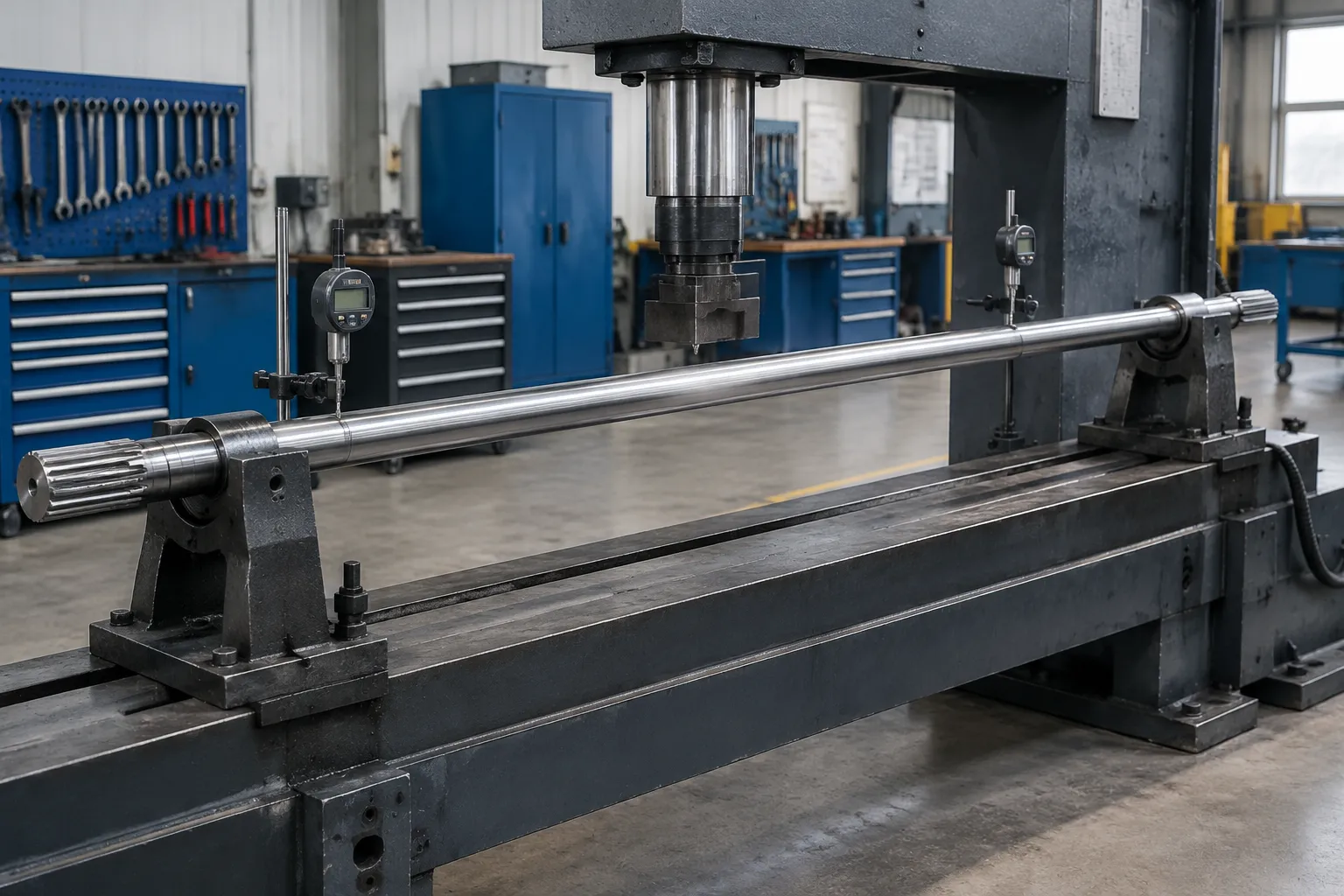
Engineering concept illustration: an ESP shaft section set up for measured correction. Not a customer-site photograph; force class, support span and acceptance limits are established on representative shafts per diameter and material family.
What an ESP Pump Shaft Is, and Why Its Geometry Is Demanding
An ESP string stacks a motor at the bottom, a protector or seal section, an optional gas separator, and a multistage centrifugal pump on top, with one rotating shaft line running through the whole assembly and individual sections joined by splined or threaded couplings. Pump impellers ride on the shaft, floated designs locating on the shaft and spinning with it, compressed designs clamping the stack, so the shaft defines both the torque path and the running geometry of every stage. Industry references state the design tension plainly: the shaft is kept as small in diameter as possible to maximize flow area and efficiency while still transmitting the motor’s full torque. Small diameter plus long length is exactly the combination that makes a shaft fragile in handling and sensitive to bend.
Materials follow the service. Manufacturers catalogue ESP shafts in ascending strength and corrosion tiers: carbon and alloy steels such as 4140-class, corrosion-resistant grades, and nickel-alloy Monel K500-class at the top, with precipitation-hardening stainless such as 17-4PH common in aggressive well environments. For straightening the tiers matter twice over: higher-strength alloys store more elastic energy and spring back more per unit of press stroke, and nickel alloys bring galling and surface-protection concerns carbon steel does not.
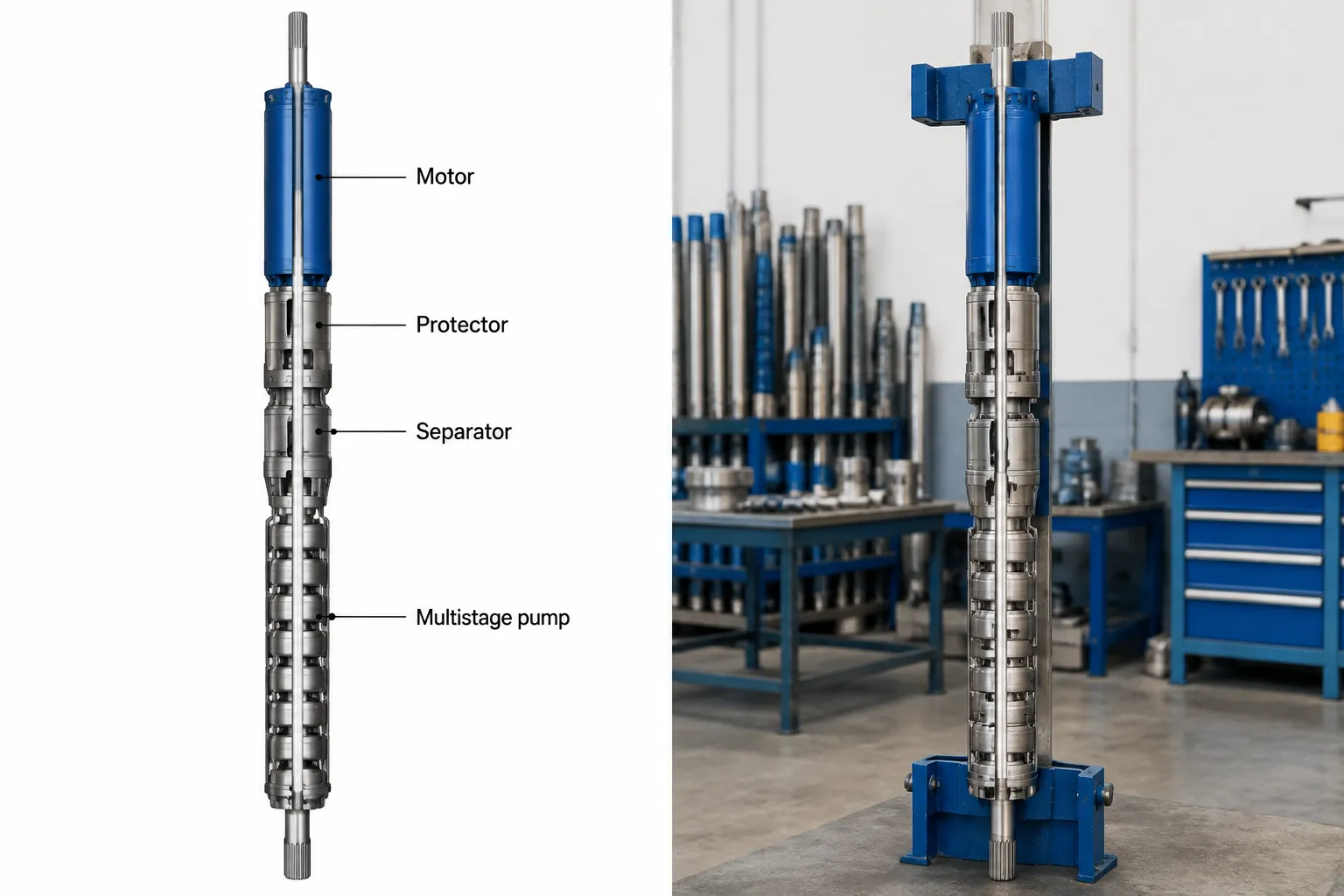
The ESP Shaft Family at Teardown
| Element | Role | Straightening interest |
|---|---|---|
| Pump shaft sections | Carry impellers, transmit torque stage to stage | Main subject: long, slender, splined ends |
| Protector and separator shafts | Connect motor output upward through seal and separation sections | Same family, shorter sections, fine journals |
| Motor shafts | Rotor-carrying shafts inside the motor | Conventional precision work, covered by automatic motor shaft straightening |
| Spline couplings | Join sections, transmit torque with float | Never a press target; datum-relevant through mesh condition |
| Generic industrial pump shafts | Surface pumps, vertical turbines, process pumps | Covered separately in industrial pump shaft straightening |
Why ESP Shafts Bend, and What Breakage Leaves Behind
Three bend sources dominate. First, handling and logistics: a 20 mm shaft several metres long deflects under its own weight and takes a set from poor support in storage or shipment. Second, service distortion: abrasive wellbore particles, scale, or a locked stage impose lateral loads and single-side wear, and published ESP failure analyses repeatedly identify shaft breakage among the top failure modes, so a shaft that ran in a binding stack exits the well with bend and fatigue history written into it. Third, teardown damage: sections are pressed apart, couplings released, short sections levered out of housings, and the same repair floor that saves shafts can bend them.
Failure history carries a second consequence beyond geometry. A section straightened back to runout can still hold fatigue damage from the failure that pulled the ESP, which is why a serious ESP repair process treats straightening and disposition as two steps: geometry can be restored; the decision to reuse a section that survived a service failure is a metallurgical judgment made to the repair shop’s own acceptance rules, not a straightening outcome.
Straighten or Replace? A Decision Tree for ESP Shafts
Not every damaged ESP shaft deserves the press, and not every bent one deserves a new part. The repair-versus-replace call is made before any measurement setup, and it is a materials-and-integrity decision first, a geometry decision second. Published failure analyses consistently locate the root event in material condition or survived load history, which is the backdrop for this triage:
- Is there a fracture or crack indication? A shaft that has parted, or that shows fatigue-crack indications under inspection, exits toward replacement. Straightening is meaningless on a part whose integrity is already compromised, and a re-straightened cracked shaft is a scheduled second failure.
- Is the bend the only finding? A measured bend with clean inspection results, no crack indications, acceptable surface and dimension, is the classic straightening candidate, following the process window described below.
- How large is the bend relative to the section? Small-to-moderate bends on a long slender shaft respond to incremental press correction. A bend approaching a kink, concentrated curvature over a short length, signals local plastic damage history, and economics tilt toward replacement: correction cycles multiply, each cycle adds cold work, and the result still carries the original event in its microstructure.
- What is the material and its history? Corrosion-resistant alloys and high-strength conditionings narrow the correction window, and a shaft straightened once before deserves a stricter hearing the second time, because failure literature keeps locating new cracks exactly where old plastic zones lived.
- What does the downtime clock say? Replacement competes on lead time as much as price. Where a spare shaft exists, straightening wins on schedule; where neither path is stocked, the repair route is often faster, which is precisely when the integrity questions above must be answered honestly rather than hopefully.
The economics, as a driver list rather than a number: material and machining cost of the replacement, lead time on both paths, inspection cost paid either way, and the confidence attached to the integrity verdict. The press cycle itself is not on the list, measurement and judgment dominate, which is why the tree starts with crack indications, not degrees of bend. The protector shaft belongs to the same family with comparable slenderness and alloys, so the triage logic transfers unchanged; that equivalence is an inference from shared geometry and duty, not a published classification.
Measurement: Datums on a Splined, Sectioned Shaft
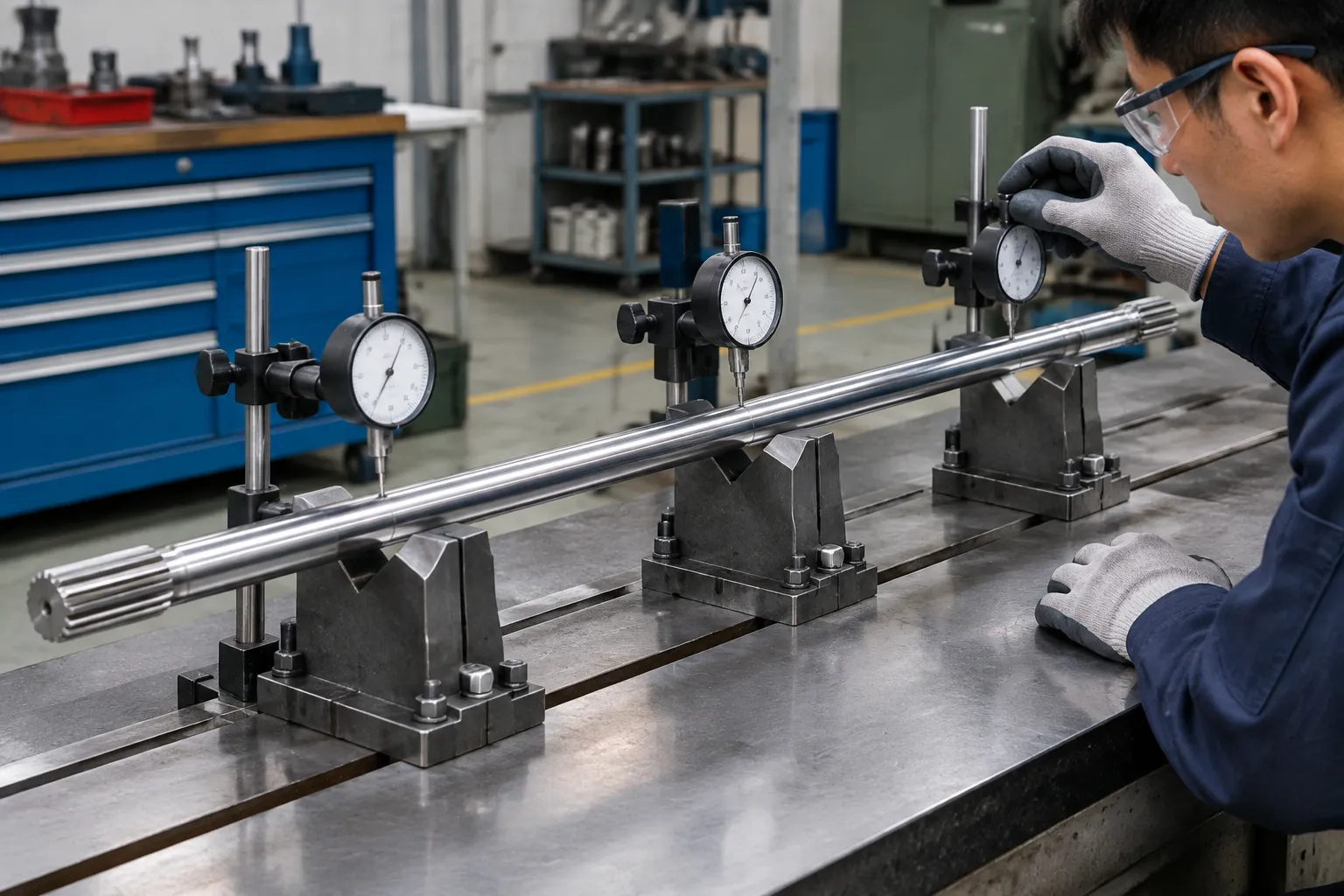
Runout only means something against a defined datum, and on an ESP shaft the candidates are the bearing and bushing journals, the centres, and the spline pitch cylinders. Journals are the running-reality datum, what actually rides in the pump’s bushings, and the first choice wherever the drawing allows. Centre-based measurement is convenient but inherits any centre damage from teardown, so centres are re-qualified before being trusted. Two ESP specifics apply on top of the general stepped-shaft datum rules: support spans shorten aggressively at these slenderness ratios, because self-weight deflection is not negligible at 15-20 mm diameters, and spline sections are read at the pitch line rather than on individual tooth flanks.
Measurement distinguishes section runout from assembly runout. Each section is measured alone; the joined line through a coupling is checked again, because spline mesh clearance adds apparent runout that no amount of shaft straightening removes. Chasing coupling float with a press is one of the classic dead ends in ESP shaft work.
Straightening Method and Process Window
The physics of an ESP shaft selects the process by itself. At these slenderness ratios the workpiece cannot be treated as a stiff beam; targeted point-press correction, measure, support, press, re-measure, keeps the correction local instead of walking the bow along the length. The press-versus-roller trade-off lands decisively on the press side: roller machines earn their keep on continuous bar and tube lines, while a two-metre splined shaft with protected features needs discrete, positioned corrections.
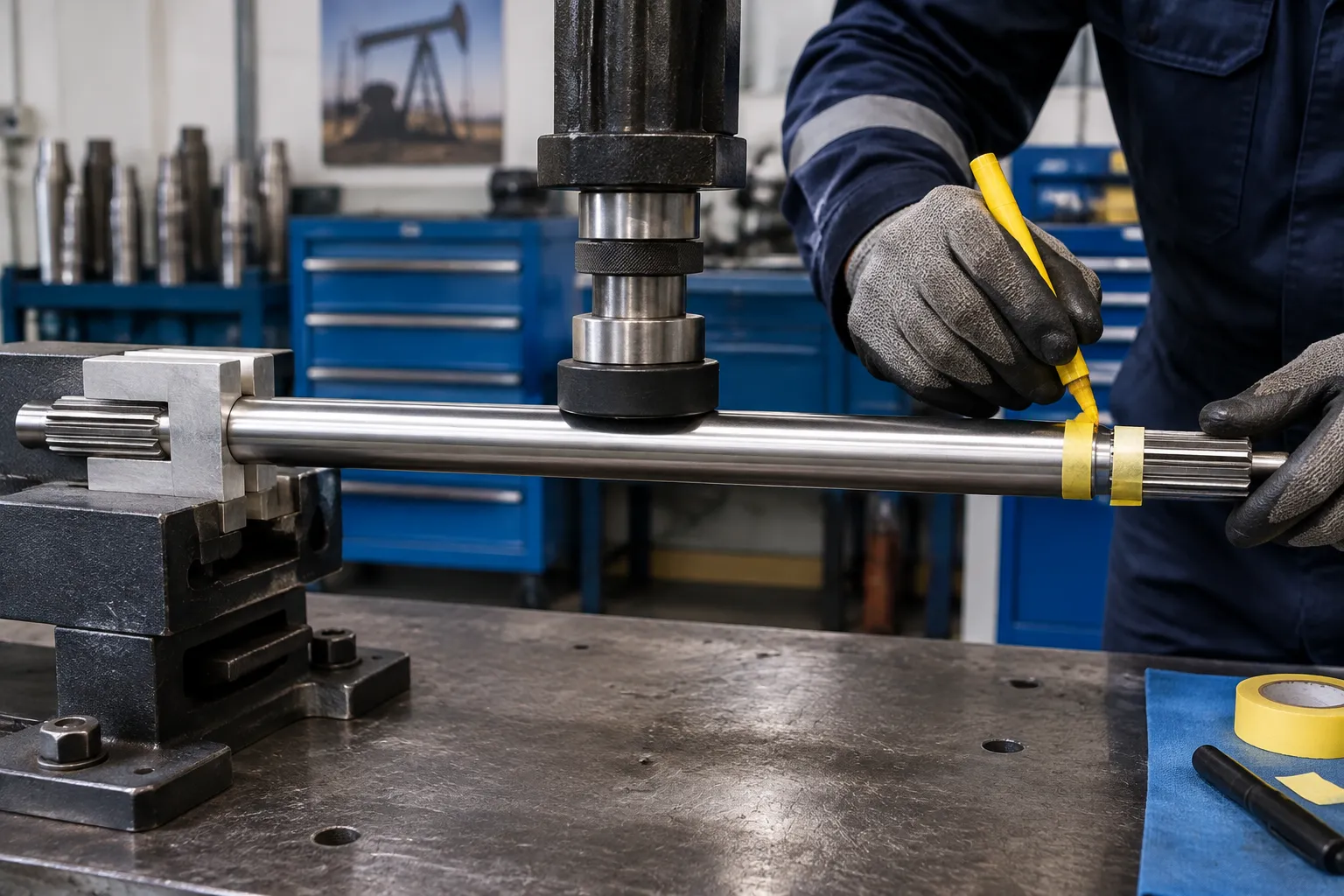
- Press points only on plain ground sections. Spline teeth, coupling threads, seal surfaces and journals never take ram contact; the press foot lands on plain stock between features, with pad materials chosen for surface protection.
- Short supports, short spans. Support spacing follows the section’s stiffness, not operator convenience; on high-strength nickel alloy the press works against real springback, so correction proceeds as multiple small presses with re-measurement between them rather than one deep stroke.
- Bend map before pressing. The section is mapped along its length first, so the operator knows whether the correction faces one bow, two opposing bows, or a local kink, each with a different press sequence.
- Heat-treatment state is declared. A shaft straightened after final heat treatment and one straightened between rough machining stages have different residual-stress behaviour, and the process card must know which it holds.
Where Straightening Sits in the ESP Repair Flow
A pulled ESP arrives at the shop as a stacked string, and shaft work happens inside a defined sequence: teardown with section identification; cleaning and initial inspection, where crack indications and gross damage surface first; non-destructive testing per the shop’s rules on suspect sections; then measurement and straightening of the sections that pass; and finally reassembly with new couplings and hardware where required. Straightening therefore never opens the flow, it responds to it. The shop that presses first and inspects later inherits every skipped gate as a field failure, while the shop that gates first presses only what inspection has already cleared. Between OEM production runs the same logic applies in miniature: sections are measured between machining stages, corrected before final grind where the process card allows, and released with a recorded map.
Common Pitfalls in ESP Shaft Straightening
Pitfall 1: straightening a vibration problem that is not bend. A downhole ESP vibrates for many reasons; a shop that measures runout before assuming the shaft is the culprit avoids re-straightening parts that were never the issue. Pitfall 2: pressing on features. One careless ram landing on spline teeth or a thread turns a repairable section into scrap. Pitfall 3: ignoring springback in high-strength alloy. Monel-class shafts pressed like carbon steel either do not move or over-move when the stored energy releases; small indexed presses are the discipline. Pitfall 4: treating post-failure shafts as raw stock. Straightening restores geometry, it does not erase fatigue. Pitfall 5: chasing coupling runout with a press. If the runout appears only after sections are joined, the spline mesh is talking, not the shaft.
Proposal Data Checklist
- diameter range and total lengths of the shaft family, per section type, pump, protector, motor;
- material and condition, alloy family, heat-treatment state, any plating or coating;
- drawing with feature map: splines, threads, journals, seal surfaces and their distances;
- required runout or straightness band and the datum it is specified against;
- whether sections arrive clean from production or with teardown history from pulled ESPs;
- volumes per diameter family and target cycle time per section.
FAQ
What does ESP mean on this page?
Electric submersible pump, the downhole artificial-lift machine used in oil and gas wells. The abbreviation also names electrostatic precipitators in other industries; nothing here concerns those.
Can a bent ESP pump shaft be straightened instead of replaced?
Geometrically yes: bend correction on slender nickel-alloy and stainless sections is routine press-straightening work when features are respected and springback is managed. Whether a specific section should be reused is a separate disposition decision, especially after a service failure; that judgment belongs to the repair shop’s acceptance rules, supported by measurement data rather than overridden.
Do Monel K500 and 17-4PH shafts straighten differently from steel shafts?
Yes, mainly through springback and surface behaviour. Higher-strength alloys store more elastic energy per press, so correction takes more, smaller presses with re-measurement, and pad materials must respect galling sensitivity. The method does not change; the process window does.
Our shafts are only slightly bent. Is measurement really necessary first?
It is the whole job. At these slenderness ratios the difference between a single bow, an S-curve and a local kink is invisible to the eye and decides the entire press sequence. A bend map costs minutes; pressing blind costs shafts.
Summary and Next Step
ESP pump shaft straightening is precision slender-shaft work with oilfield specifics: nickel-alloy springback, protected splines and journals, section-versus-assembly runout, and fatigue history that gates reuse. Map the bend against journal datums, press only on plain stock in small indexed steps, and validate per diameter family on sample sections. For the adjacent drilling-side sister workpiece see mud motor rotor straightening, and for the equipment family overall the shaft-type parts straightening overview. If you rebuild ESPs or manufacture shaft sections, send the diameter range, materials and runout targets, and the validation plan follows from real sections.