
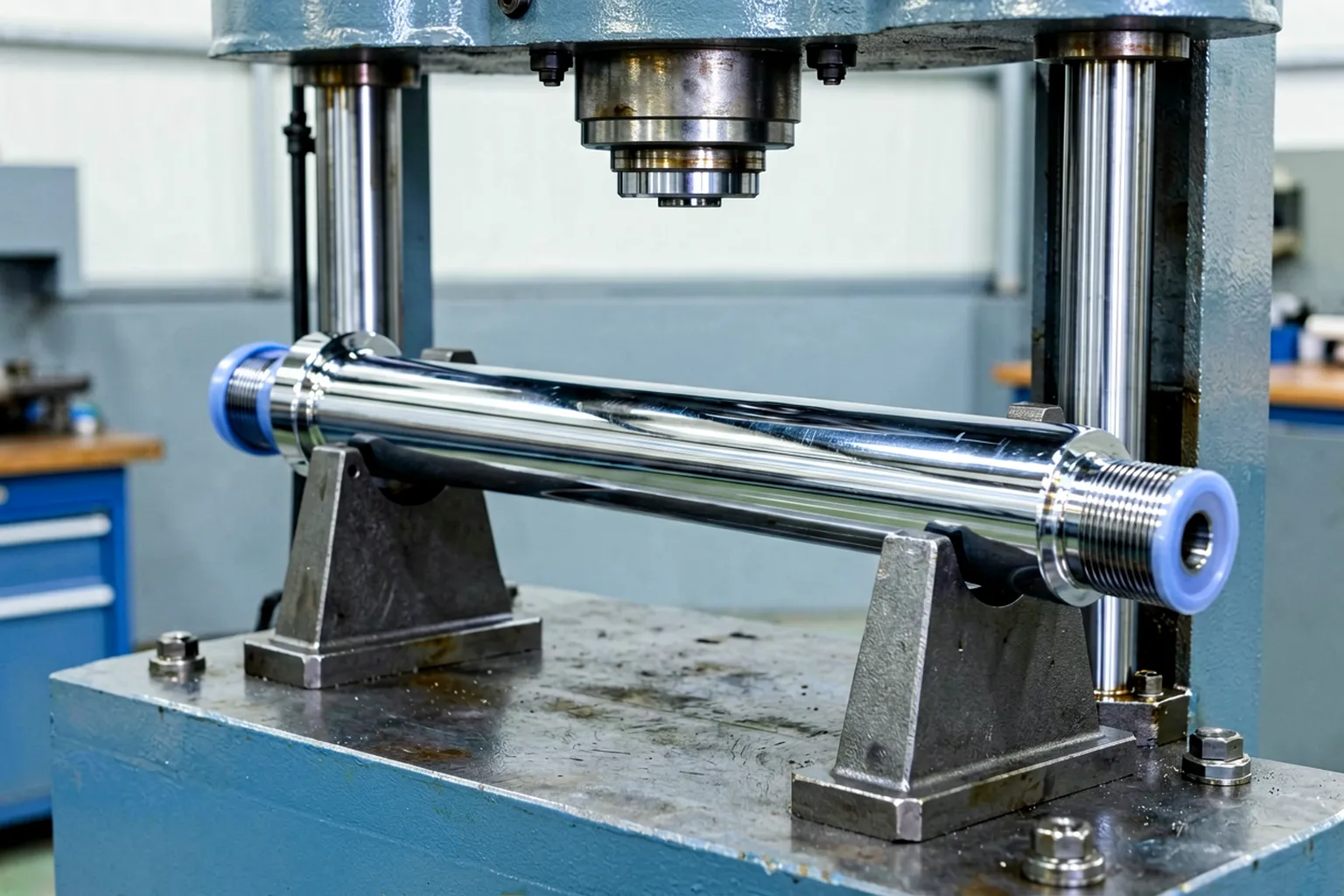
A reciprocating compressor piston rod is the muscle-tendon of gas midstream infrastructure: a forged alloy steel rod, commonly tens of millimeters to around 150 mm in diameter and several feet long, that links the crosshead to the piston and pulls and pushes every compression stroke in gas gathering, processing and pipeline booster service. One stretch of its length is a precision sliding surface running through the pressure packing; its ends carry the crosshead and piston connections. When a compressor ingests a liquid slug, eats debris, or simply comes off alignment, the rod bends — and rod straightening is one of the core operations inside the piston-and-rod repair services run by the industry’s largest compressor specialists. Yet almost nothing public describes how that work is actually controlled. This page does.
The search evidence is a study in contrast. At the top of the results sit formal repair service lines from two of the biggest names in compression — a “Compressor Piston and Rod Repair Services” program from one, a piston and piston rod repair (PRR) offering from the other — which is as hard a B2B demand signal as this industry prints. Around them, the results fall apart into do-it-yourself territory: straightening an aluminum connecting rod on a small shop air compressor, hobby-machinist threads about straightening thin rod, even soldered-instrument repair pliers. Scope discipline for this page is therefore explicit: we cover rods from industrial reciprocating gas compressors — the oil and gas midstream workhorse — not small air compressor connecting rods, and not hydraulic cylinder rods, which have their own page in piston rod straightening.
Five questions frame a compressor rod straightening solution:
- Is the rod coming out of a planned overhaul or after a failure event — liquid slug, piston seizure, debris — that bent it?
- What are the diameter, length, and material condition, and is the sliding surface hard-chrome plated, coated, or bare?
- Which regions may take press contact — and how are the packing sliding surface, thread runs and connection flanges protected?
- Is the deviation a single bow along the length, a local bend near one connection, or twist-plus-bend from a seizure event?
- What runout band does the compressor OEM or your repair standard require, measured against which datum surfaces?
What a Compressor Rod Is — and What Runs on It
Walk the drivetrain of a reciprocating compressor and the rod’s job becomes clear. The crankshaft turns; a connecting rod translates rotation to reciprocation at the crosshead; the piston rod then crosses the frame pressure boundary and drives the piston inside the cylinder. Every stroke loads the rod in tension and compression; the section passing through the pressure packing is a sealing surface that must stay straight and smooth for the packing rings to seal and survive. Rods are forged alloy steel, heat-treated for strength and fatigue resistance, with the sliding length commonly protected by hard chrome plating or engineered coatings depending on gas composition and packing design. The frame-side discipline for the crankshaft member of the same drivetrain is covered in crankshaft straightening.
The functional feature map is what straightening must respect. At the crosshead end: a flange or threaded connection that locates the rod to the crosshead. At the piston end: threads, a shoulder and a nut that clamp the piston. Between them: the precision sliding surface, plus transition necks. Straightness is not cosmetic on this part — a bowed rod drags the piston off the cylinder bore axis, accelerates packing wear, and feeds vibration back into the frame, which is why compressor OEM and specialist repair literature treats rod geometry as an overhaul acceptance item.
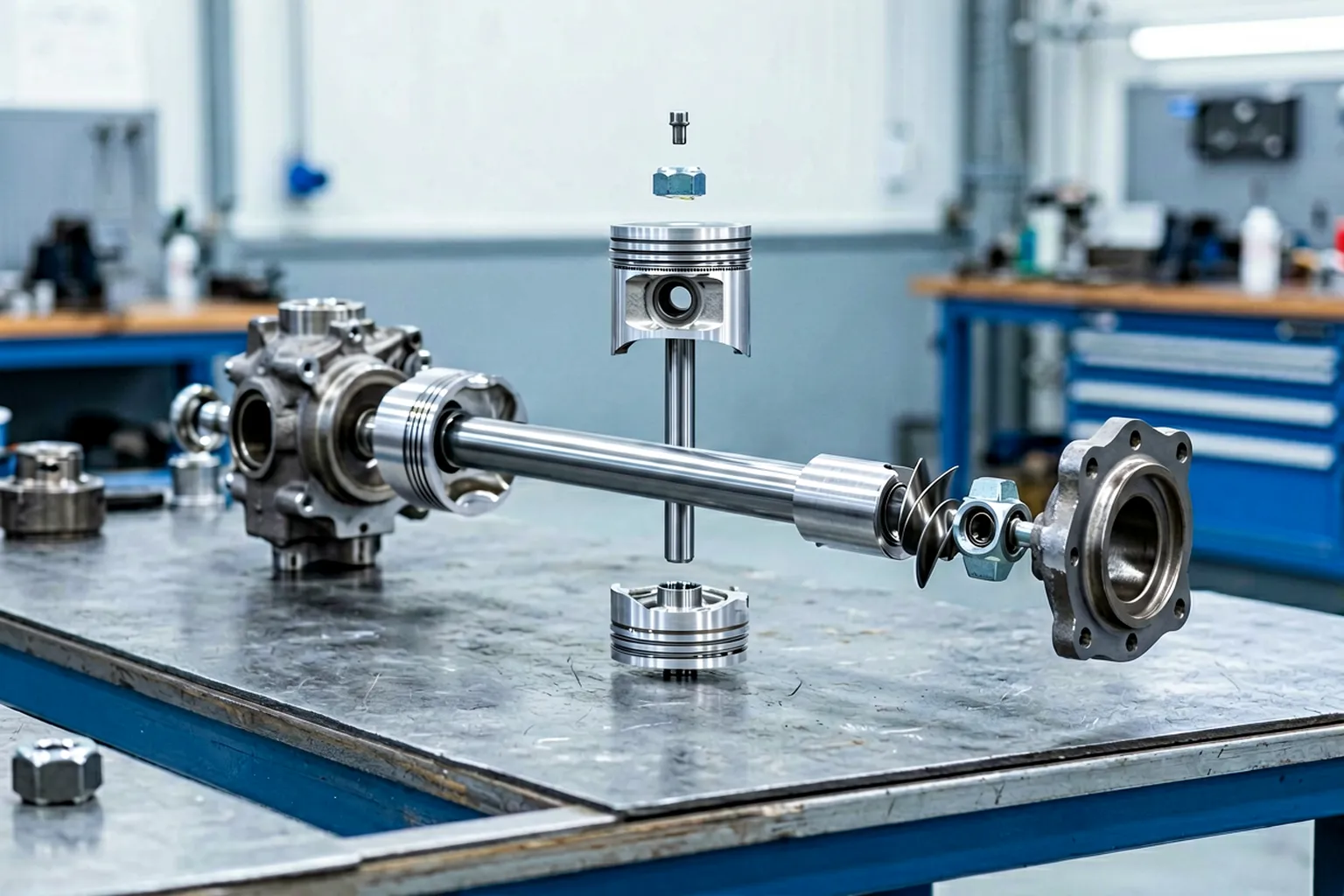
The Rod Family — and Two Naming Traps
| Element | Context | Straightening Interest |
|---|---|---|
| Compressor piston rods (this page) | Reciprocating gas compressors, midstream and process service | Subject — large precision rods, plated sliding surface |
| Crosshead-side connection parts | Flanges, nuts, pins of the crosshead joint | Adjacent machined parts, conventional precision work |
| Compressor crankshafts and connecting rods | Same drivetrain, different geometry | See crankshaft straightening for the frame-side discipline |
| Hydraulic cylinder piston rods | Fluid power cylinders | Covered in piston rod straightening |
| Small air compressor connecting rods | Shop compressors, aluminum castings | Different part entirely — not straightening stock |
The traps: a search that mixes “piston rod” with hydraulic cylinders lands in a different industry, and the aluminum connecting rod of a shop air compressor is not this workpiece at all. When a repair inquiry says “compressor rod,” confirm frame size, rod diameter and service before quoting anything.
Why Compressor Rods Bend
Four sources account for most bent rods in overhaul intake. Liquid carryover: an incompressible slug entering the cylinder stops the piston on compression stroke; the rod takes a compressive overload it was never sized for and bows. Debris and piston seizure: fragments or a seized piston overload the rod laterally. Assembly and alignment faults: a rod working against a misaligned crosshead or an off-bore cylinder wears and bends on a schedule. Handling: rods removed during overhaul are long, heavy and surface-critical; a drop or poor support between stands writes its own bend map. After any of the first three, the rod also carries overload history — which is why the specialist repair flow treats inspection, non-destructive testing and geometry correction as one gated sequence rather than jumping straight to the press.
The Repair Economy Around the Rod
That the two largest compression specialists both operate piston and rod repair service lines tells the commercial story: rods are worth saving when their geometry and surfaces can be restored to acceptance. Public service descriptions span inspection, correction, machining and surface restoration. What they do not publish is process depth — and this page’s position is the one we take across this site: the restore-versus-replace decision rides on rod condition class (bend magnitude, surface state, overload history), turnaround economics, and the acceptance rules of the OEM or fleet owner. We supply the geometry restoration step inside that decision; the disposition call and its economics belong to the repair program that owns the machine.
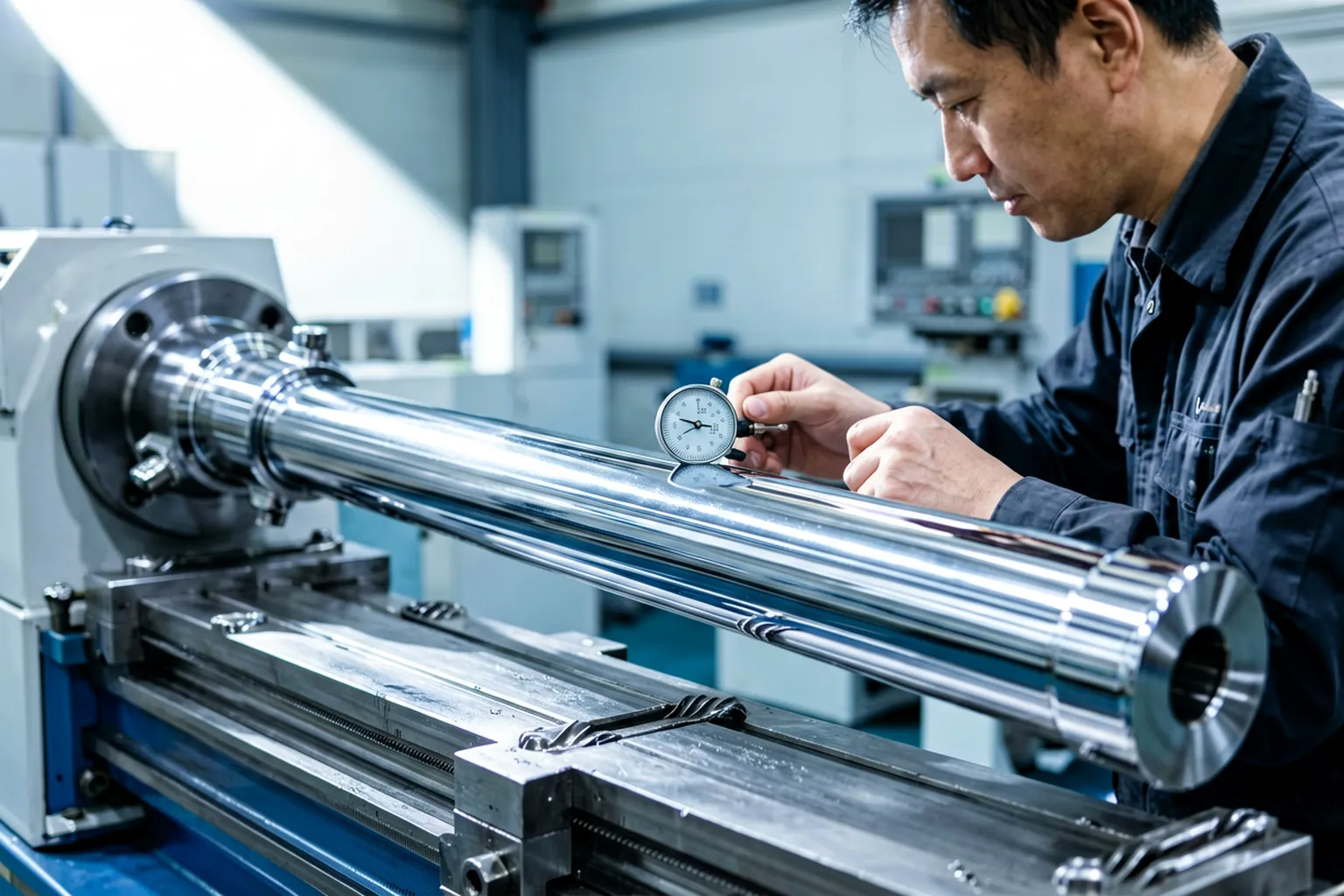
The Fracturing Pump Plunger — the Same Discipline, at Higher Duty
The reciprocating chrome-plated cylinder family does not end at compressor rods. Fracturing pump plungers belong to it: long, slender, hard-chrome-plated cylindrical components that convert rotating drive into the fluid-end pulse of a frac pump, under some of the heaviest cyclic loading in pressure pumping. Geometrically and functionally they are cousins of the compressor piston rod — chrome working surface, close straightness expectation, fatigue-dominated service — and the repair discipline around them follows the same shape.
Why they bend mirrors the compressor side, intensified: sustained axial pulsation from the fluid end, side-load components from alignment error between power end and fluid end, and handling in the field. A bent plunger or rod in a frac pump announces itself quickly — packing and packing-nut life collapse first, then the pump’s efficiency and the component’s own surface. Fluid-end repair providers publicly discuss the rebuild-or-replace decision at the pump level, which is the same economic question this article asks at the rod level, one component deeper.
The repair-shop sequence for a chrome-plated reciprocating member is where the families genuinely converge:
- Measure before anything moves. The bend map on the full length, taken on the working-surface datums, decides whether the part is a straightening candidate at all — plunger straightening economics fail fast on parts whose damage is dented, galled or scored rather than simply bent.
- Straighten the body, protect the chrome. Press correction acts on the substrate; support and press-point contact avoids the chrome working band and any shoulders or threads, the contact discipline this page applies to compressor rods carried over unchanged.
- Reground, then re-plated, then final geometry. In described practice for plated reciprocating parts, the plating is stripped or dressed, the surface is reground, and re-plating follows — which puts straightening upstream of grinding, because grinding to final size on a bent bar only reproduces the bend in an expensive new surface. The order straighten → regrind → re-plate is the repair-logic default (sequence inference from published plating-and-grinding practice, not a single shop’s stated flow).
- Verify against the packing datum. Final runout is judged where the part seals — the packing region — because that is where residual geometry error converts directly into leakage and wear.
One caution separates the plunger from the compressor rod: the fluid-end environment adds abrasion and corrosion mechanisms on top of fatigue, so a plunger that qualifies geometrically may still fail the surface-integrity review that precedes re-plating. Straightening restores the bar; it does not certify the surface, and a re-plated plunger is only as good as the substrate assessment underneath it. For shops already running compressor-rod straightening, adding fracturing pump plungers is a scope question more than a process question — the measurement stations, press discipline and chrome-zone protection carry over, with dimensions and acceptance targets set per pump model. The neighboring pages on industrial pump shafts and ESP pump shafts cover the same discipline applied to the other two branches of the reciprocating-shaft family.
Measurement: Datums and Setup
The honest datum set on a compressor rod is its functional end surfaces — the crosshead connection face or journal, and the piston-end thread shoulder or center — with runout read along the body and, critically, at the packing sliding length. The datum-selection logic parallels stepped-shaft practice: reference the functional faces, qualify centers before trusting them, and keep support spans tight enough that a heavy rod does not sag its own reading. Rotation-based measurement on paired supports, bend-mapped at several stations, tells the operator whether the correction is one bow or two opposing bends — the difference decides the press sequence.
Straightening Method and Process Window
A rod in this class is a stiff workpiece at a real length: correction takes decisive force at mapped locations, delivered as point-press straightening rather than roller passage. The process rules that matter:
- Protect the sliding surface absolutely. Ram feet and supports never land on the packing length; contact stays on plain necks and non-functional stock with soft, load-spreading pads — the surface-protection discipline applied to all finished cylinders on this site, stricter here because the plated surface is a sealing partner, not just a cosmetic one.
- Small indexed presses on high-strength forgings. Heat-treated alloy forgings carry real springback; correction proceeds press–measure–press until inside the band, rather than one over-correction stroke.
- Respect the plating. Bending a plated rod — and bending it back — strains the chrome layer; a re-straightened rod’s sliding surface is re-inspected for plating integrity before release, because a straight rod with cracked plating is a delayed failure, not a repaired one.
- Declare any prior weld repair. Rods that went through weld build-up and re-machining carry local hardness and residual-stress states that change the press plan; the process card must know the rod’s full repair history.
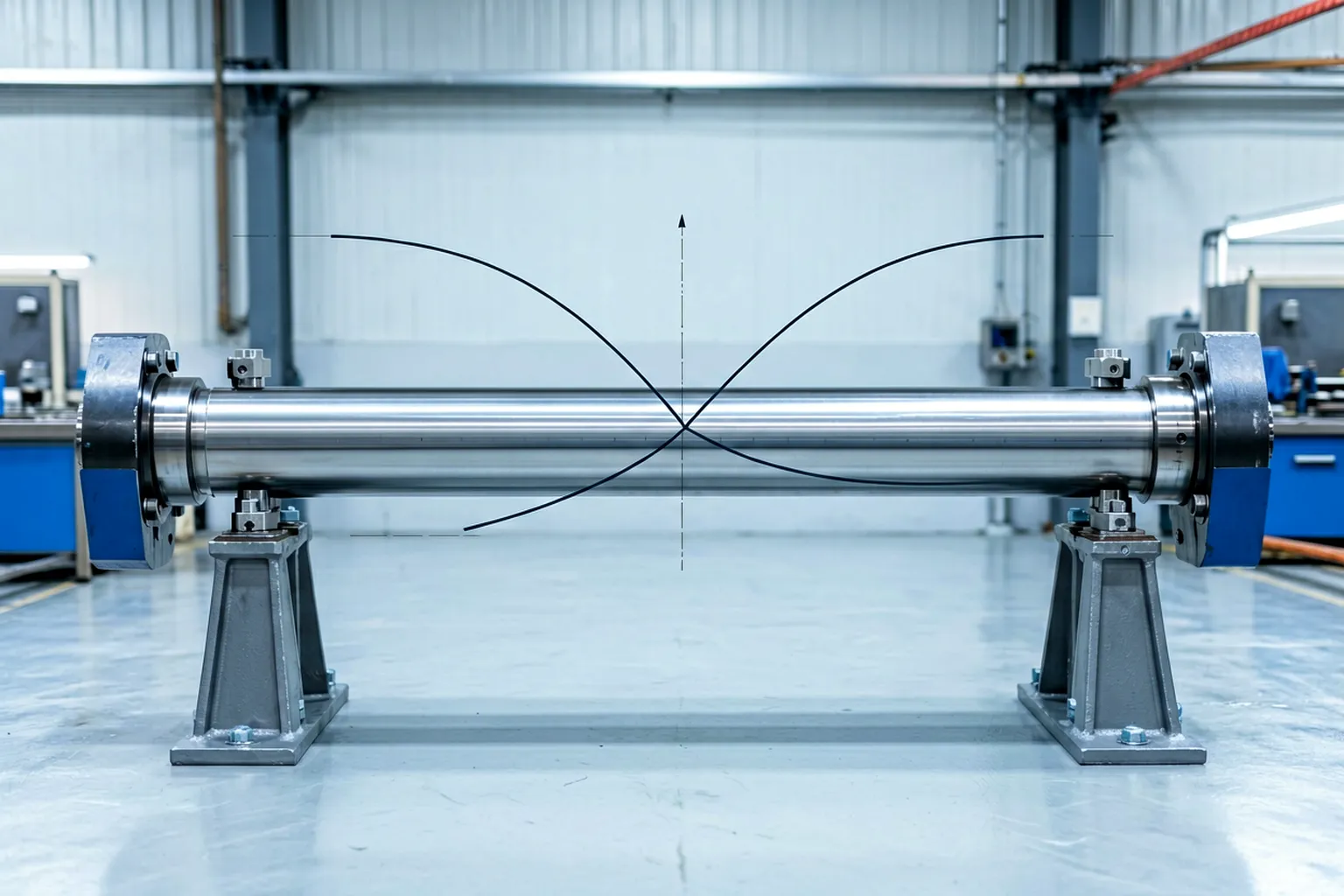
Common Pitfalls in Compressor Rod Straightening
Pitfall 1 — pressing on the packing length. One hard pad mark on the sliding surface can condemn the rod regardless of runout. Pitfall 2 — straightening past the inspection gate. A rod from a liquid-slug event may be both bent and cracked; correction before NDT risks polishing a part that should never go back. Pitfall 3 — ignoring springback on heavy forgings. Under-pressing wastes setups; over-pressing a stiff rod overshoots the band and work-hardens the correction zone. Pitfall 4 — accepting body runout only. The packing length is the functional witness; if runout is read only at mid-body, the region that matters goes unmeasured. Pitfall 5 — losing the repair history. A rod’s straightening, welding and plating record is part of its service fitness; a shop that straightens undocumented rods is building someone else’s future failure.
Proposal Data Checklist
To scope and validate a compressor rod straightening process, we ask for:
- Rod diameter range, lengths, and feature map (packing length, thread runs, connection geometry)
- Material specification and heat-treatment state, plus any weld-repair or re-plating history
- Surface condition of the sliding length: chrome, coating, or bare — and whether re-plating follows straightening
- Required runout band and datum surfaces per OEM or fleet standard
- Failure context: planned overhaul versus liquid-slug or seizure events
- Volumes by frame class and target turnaround
FAQ
Is this about small air compressor rods?
No. This page is about piston rods from industrial reciprocating gas compressors — the machines in gas gathering, processing plants and pipeline booster stations. The aluminum connecting rods in shop air compressors are different parts with different economics, and the DIY threads that dominate general searches concern those.
Can a bent compressor piston rod be straightened?
Yes — geometry restoration on heavy compressor rods is standard work within professional piston-and-rod repair flows, the same service lines the major compression specialists operate. The gate is condition: a rod from a liquid-slug or seizure event is inspected and NDT-checked first; straightening is the geometry step inside that sequence, not a substitute for it.
What about the chrome plating?
The sliding surface is protected from all press contact during straightening, and a re-straightened plated rod has that surface re-inspected — bending strains plating, and a straight rod with compromised chrome is a future packing failure. Rods whose plating cannot pass re-inspection go to strip, re-straighten and re-plate routes, which our process supports in sequence.
How straight does the rod need to be?
Tighter than a bare shaft, because the rod’s straightness sets piston alignment in the bore and packing life. The numeric band comes from the compressor OEM or the fleet owner’s overhaul standard — we build the process to the specified runout at the specified datums rather than quoting a generic number.
Summary and Next Step
Compressor rod straightening is heavy precision work with a protected heart: map the bend against functional datums, keep every contact off the packing length, press in small measured steps, and gate the whole operation behind inspection of both geometry and plating. If your facility overhauls reciprocating compressors — or you run a rod repair line — send the rod family, diameters, surface conditions and acceptance standards. For the adjacent oil and gas slender-part disciplines, see ESP pump shaft straightening and mud motor rotor straightening.
Related Reading
See also: Shaft Straightening Solutions, How Automatic Shaft Straightening Works.