
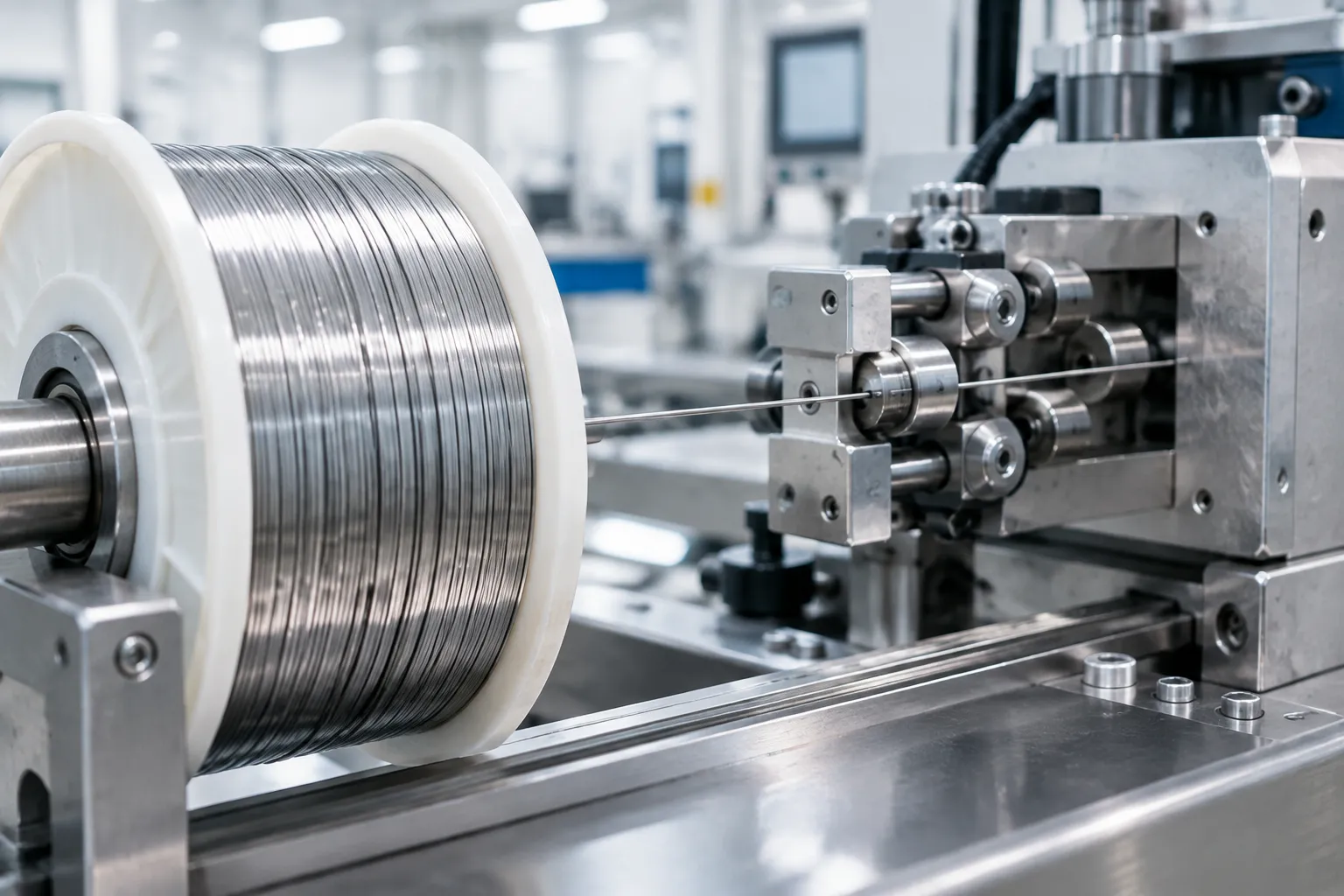
Few metal components carry consequences like medical wire. A guide wire that enters a coronary artery, a spring coil that occludes an aneurysm, a Kirschner wire that pins a fracture — in each case the wire’s straightness is a functional, and often a clinical, requirement. That is why medical wire straightening equipment is built to a different standard from ordinary wire processing: straightness accuracy of 0.05 mm per 1,000 mm, achieved with intelligent control, multi-wheel straightening systems, and precise tension control.
This article summarises what matters when straightening wire for medical devices: the materials involved, the device families and their diameter ranges, the automated correction cycle, and the machine features that make high-tensile wire processing repeatable.
What a Medical Wire Straightening Machine Must Handle
Medical wire cutting-straightening machines process both solid wire and capillary (hollow) tubing across an unusually wide material range: gold, silver, copper, iron, aluminium, titanium, molybdenum, stainless steel, and spring steel. Titanium and molybdenum in particular combine high strength with narrow process windows, so the machine must control stroke and tension rather than apply fixed force.
Beyond accuracy, the non-negotiables in this field are surface integrity and stability. The cut must be smooth and the wire surface free of scratches or damage — any mark on an implantable or intravascular component is a defect. Equipment therefore includes automatic operation-stability detection with early warning and alarm functions, plus output-setting functions for consistent batch results. Automatic material feeding and cutting integrated in one line keep handling damage out of the equation entirely.
The same capability set serves aerospace, automotive parts, electronics and electrical appliances, precision instruments, wire crafts, and electric shafts — but medical work adds the strictest surface and traceability expectations of all.
Cardiovascular Interventional Devices
Cardiovascular devices concentrate the tightest requirements: precision alignment of guide wires and catheter core materials in the 0.1–2.0 mm diameter range. A guidewire with residual curvature does not track predictably through tortuous anatomy, and core material bow translates into catheter whip. Typical parts include:
- Guide wires
- Diagnostic guidewires
- Stent delivery system components
- Balloon catheter core material
At these diameters, measurement resolution — not press force — is the limiting factor, which is why micro-wire cells use non-contact or fine-contact sensing and closed-loop correction.
Neurointerventional Devices
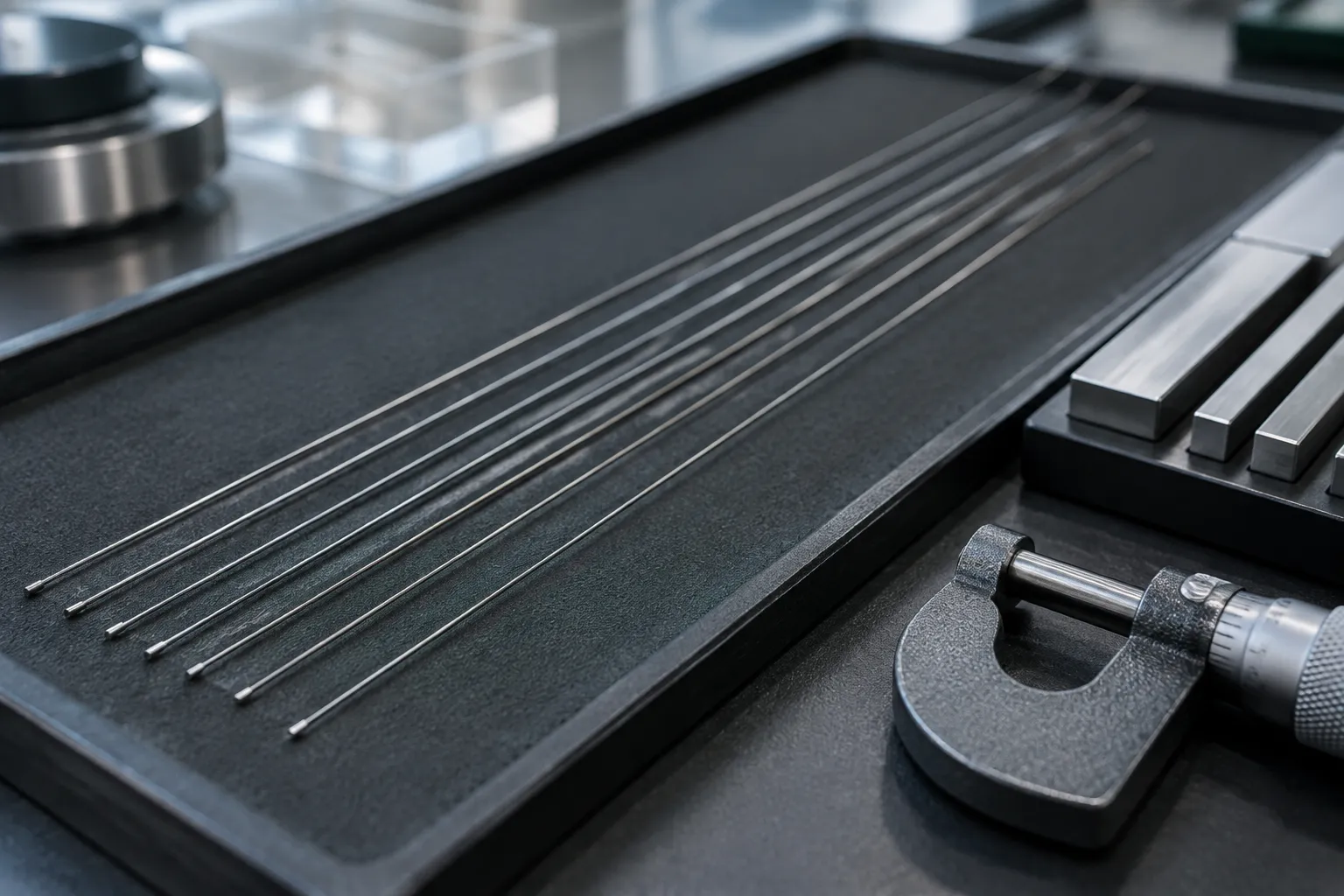
Neurointerventional work goes finer still: micro-wire straightening technology processes 0.1–0.5 mm ultra-fine wire, where a human hair is a comparable scale. Parts in this family:
- Nerve guidewires
- Embolic spring coils
- Thrombus removal stent wire
- Nerve conduit core material
At this scale, tension control during unwinding and the transition into the straightening dies decide the result; excessive tension work-hardens and necks the wire, insufficient tension lets coil memory persist. The multi-wheel straightening approach with individually adjusted rolls progressively removes curvature without marking the surface.
Orthopedic Instrument Wire
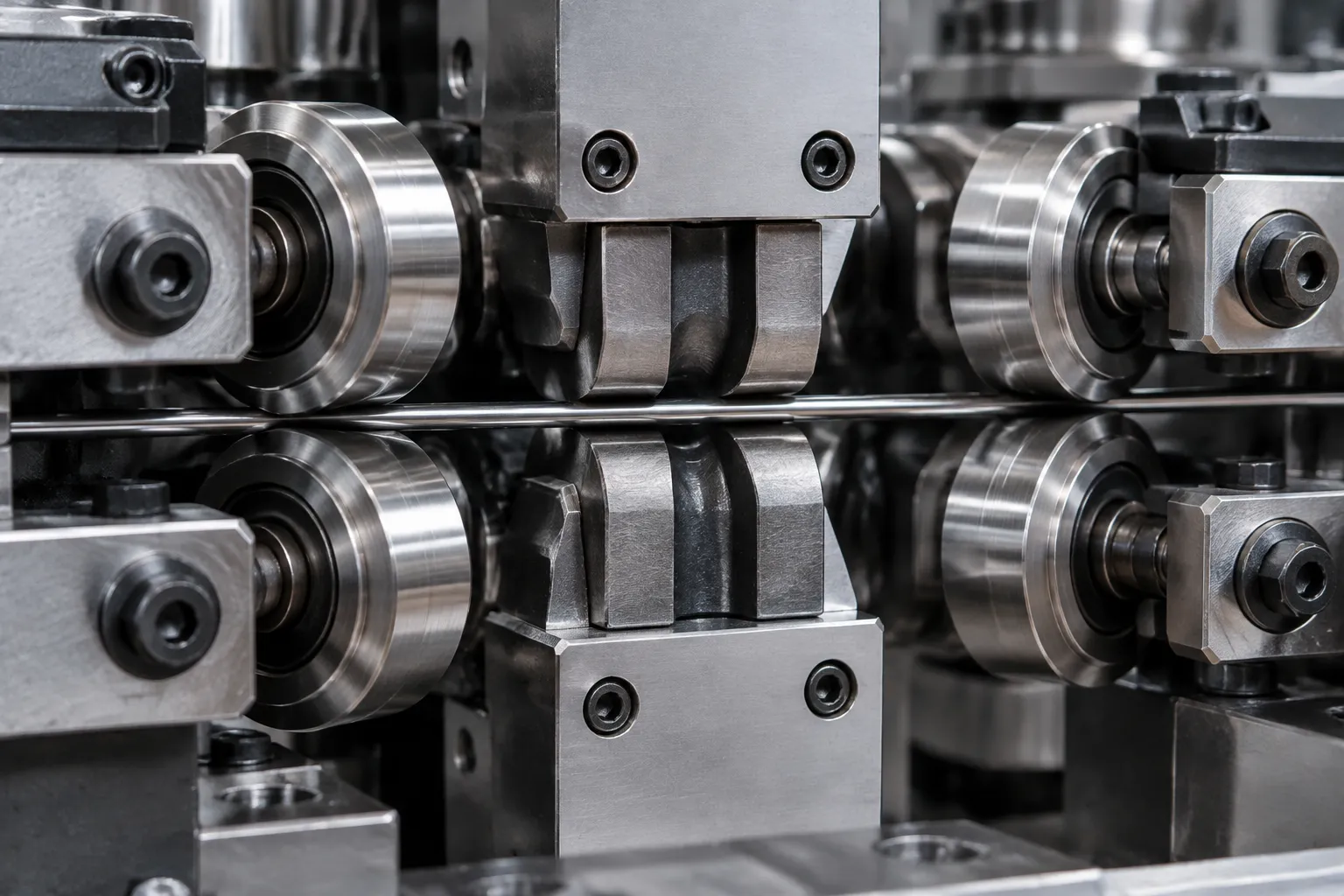
Orthopedic applications prioritise strength alongside accuracy: Kirschner wires, positioning wires, orthopedic springs, and fixation wires must be straight enough to drill or drive true, and strong enough to hold fixation. The special alignment process preserves the strength of the work-hardened wire while meeting clinical straightness requirements.
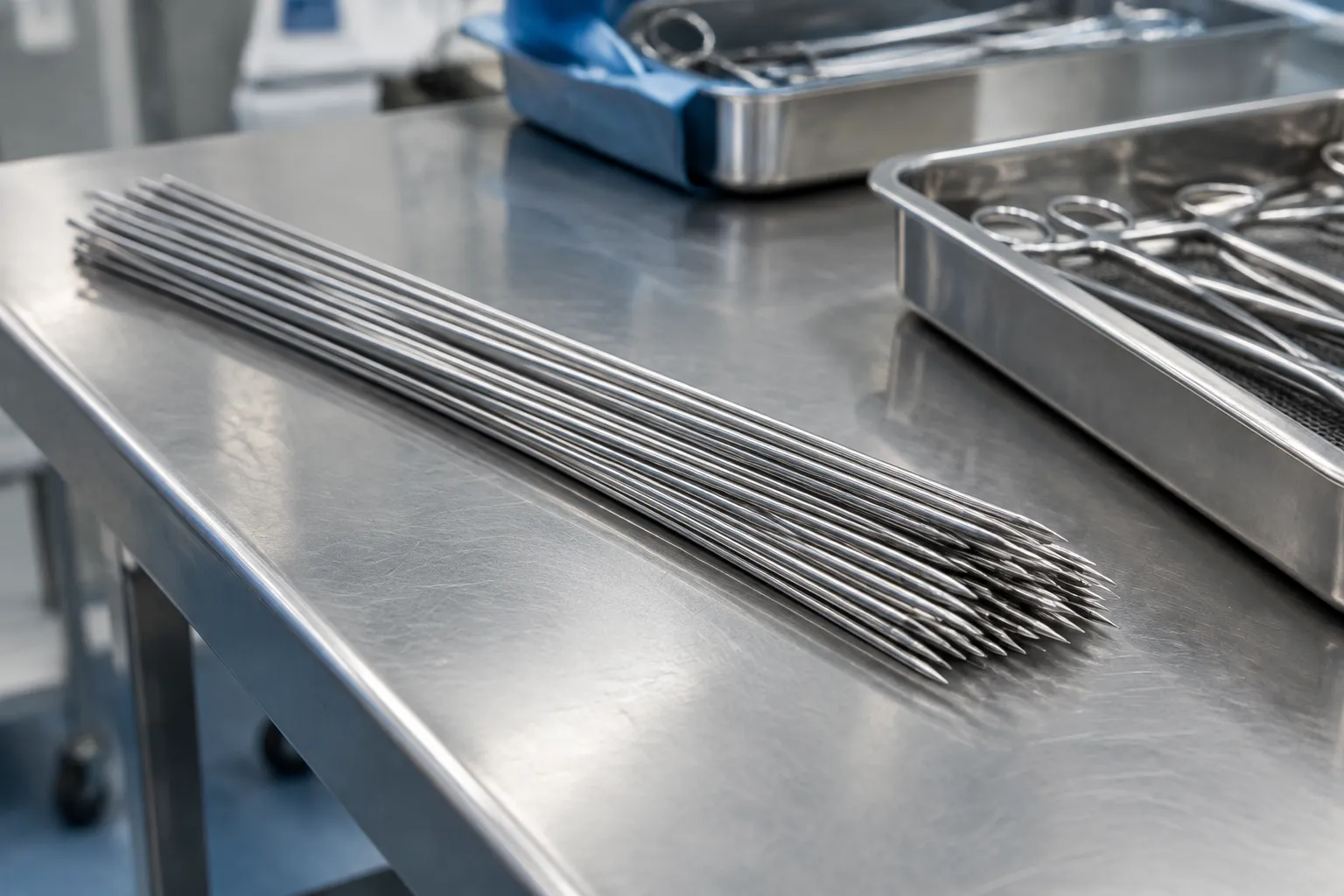
The dedicated K-wire straightening solution covers fixturing and acceptance limits for this family; for related micro-diameter work in stainless steel, the fine stainless steel wire process guide details cut-and-straighten parameters.
The Automated Straightening Cycle
In an automatic straightening cycle, the operator only loads and unloads parts — on a conveyor or directly into the straightener — and presses the auto-start button. The machine then executes the entire correction by itself:
- Measure the bend defect
- Locate the straightening points
- Press and straighten
- Check that the bend is removed
The measure–press–re-measure loop repeats until the part meets specification, with no operator judgment in the loop. For medical production, this closed loop is what makes 100% verification practical at batch scale.
High-Tensile Wire: Machine Features That Earn Their Keep
High-tensile wire — generally above 100,000 PSI — resists correction and punishes mediocre equipment. Four machine features address it directly:
- Proprietary twin-arbor counter-rotating system, ideal for high-tensile wire where single-direction rotation would simply add twist while removing bend.
- High-speed counter-rotary arbors with five die positions, giving the flexibility to straighten all types of high-tensile wire; specialty dies provide the desired wire finishes.
- Positive-stop gauge rod and release mechanism, which virtually eliminates scrap from wedging while giving the operator rapid, easy adjustment and setup.
- Edge-sensing proximity sensor target with a pneumatically controlled tripping mechanism, providing instantaneous activation of a synchronous clutch and cam cut-off system — minimising dwell time on the shear and holding cut precision within 1/64 inch.
Together these keep cut length and straightness coupled: a perfectly straightened wire cut to the wrong length is still scrap.
Related Medical Component Guides
Medical wire is one branch of medical device component straightening. For solid needles, see the medical needle straightening guide; for surgical drilling tools, the medical drill straightening overview covers the flute-and-margin geometry involved. The full component landscape is mapped in the medical device solutions hub.
Machine configurations for wire diameters from 0.5 mm upward are covered in the wire straightener product family.