
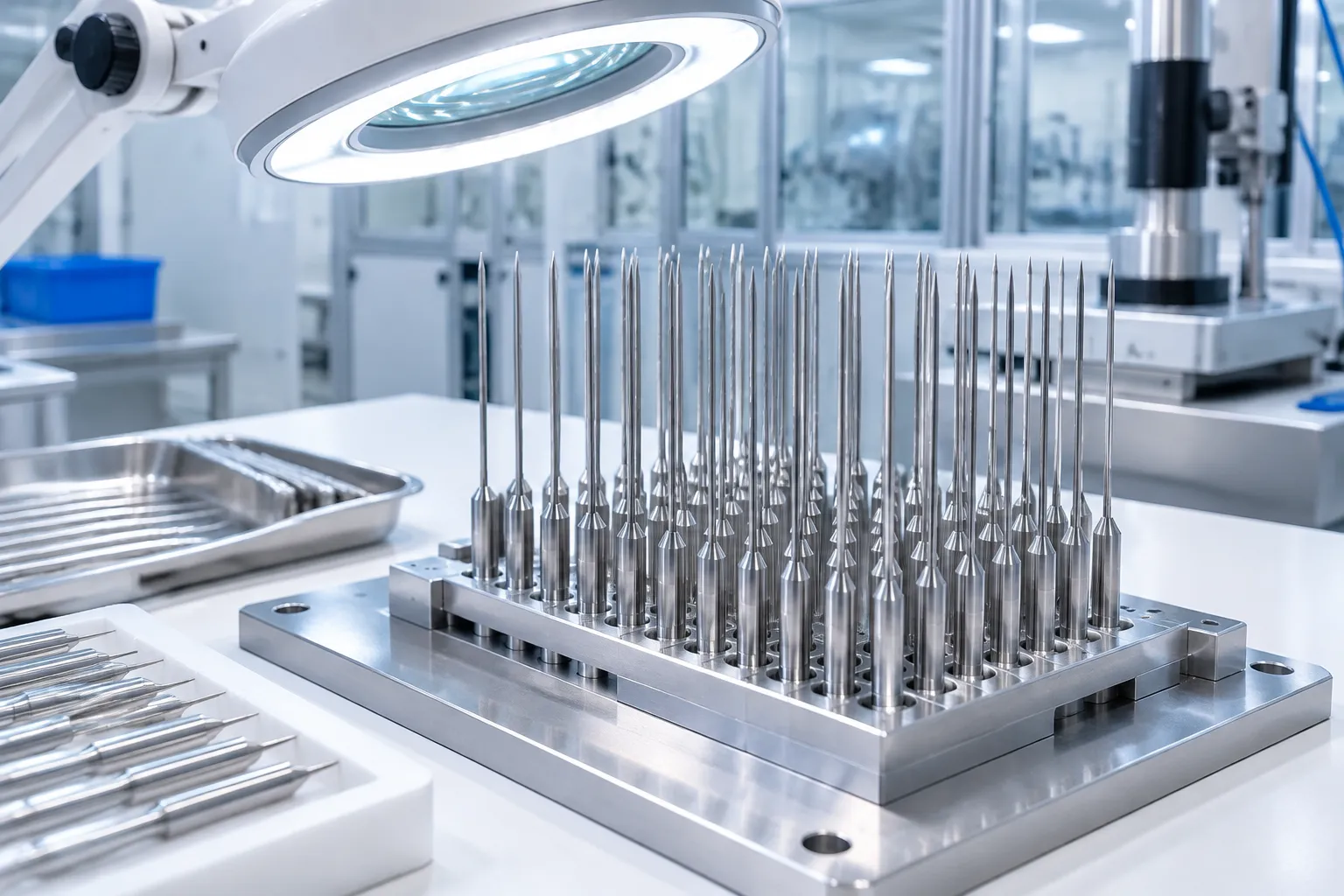
A medical needle straightening machine is built for one of the most demanding micro-scale correction tasks in device manufacturing: guide pins, puncture needles and biopsy needles whose function depends on sub-0.01 mm alignment of tubes that are barely visible to the eye. As a needles machine manufacturer, we supply the straightening and cutting equipment behind needle lines — with the precision pressure control and multi-stage correction that clinical use requirements demand.
What a Medical Needle Line Asks of the Machine
Needle work differs from general wire straightening in three ways:
- Scale — capillary and hollow needle tubing deforms under probe force alone, so the measurement strategy must protect the part while still finding bends.
- Surface law — the cut must be smooth and the surface scratch-free; any tooling mark on a needle tube is a functional defect.
- Traceability — process stability detection, early warning and alarm functions with output counting are baseline expectations in device plants.
The machine scope covers precision straightening and cutting of metal wires and capillary (hollow) pipes in gold, silver, copper, iron, aluminum, titanium, molybdenum, stainless steel and spring steel — the full material set that medical, aerospace, electronic and precision-instrument lines feed through it.
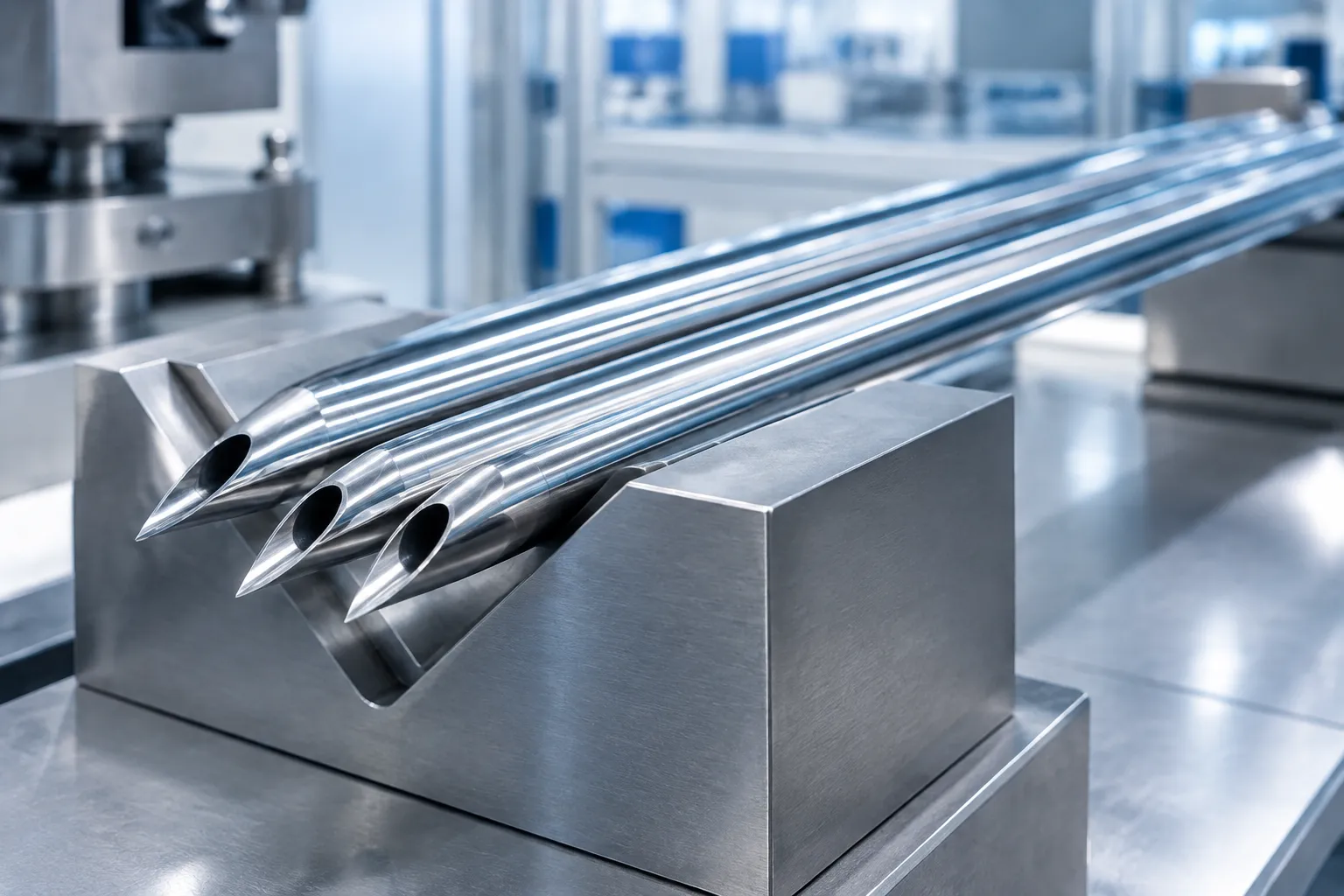
Needle Families and Their Requirements
Guide Pins
Used for surgical positioning and guidance; high-precision alignment governs positioning accuracy and surgical safety.
- Orthopedic guide pin
- CT guide needle
- Surgical positioning needle
- Nerve block needle
Puncture Needles
Across puncture procedures, precision alignment is what keeps the tip on the intended path — the safety argument for machine-straightened stock.
- Lumbar puncture needle
- Venipuncture needle
- Biopsy needle
- Contrast puncture needle
Biopsy Needles
Tissue sampling depends on ultra-precision alignment to deliver sampling accuracy with minimal invasiveness.
- Soft tissue biopsy needle
- Bone marrow biopsy needle
- Liver biopsy needle
- Breast biopsy needle
Machine Architecture: Straightening and Cutting in One Cell
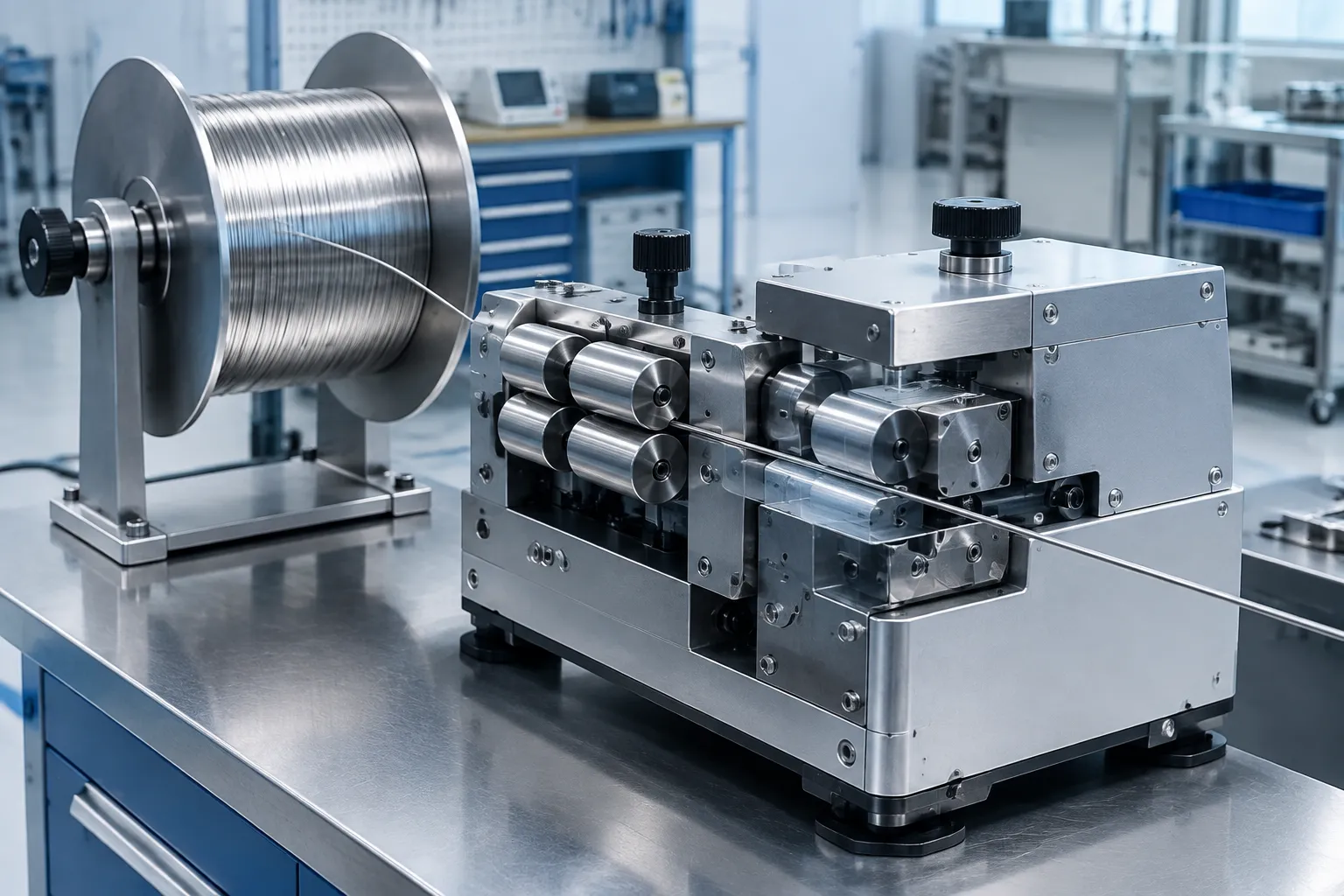
The needle straightening machine combines wire pay-off, multi-stage straightening, precision cutting and collection:
- Feeding — spool or bar stock with tension control; syringe auto loader integration is available for downstream assembly.
- Multi-stage straightening — successive roll and fixture stages remove distributed bow, then micro-correction stages resolve residual local bend.
- Cutting — the cut is smooth and burr-controlled; the surface stays smooth without scratches or damage.
- Automatic operation stability detection — early warning, alarm and output setting functions run through the cycle, so a drift in feed or alignment stops the line instead of producing scrap needles.
The full automatic cycle logic mirrors our standard cells: the operator loads and unloads on a conveyor or directly at the straightener, presses auto start, and the machine measures the bend defect, locates straightening points, presses and straightens, then checks that the bend is removed.
Quality Controls Specific to Needle Work
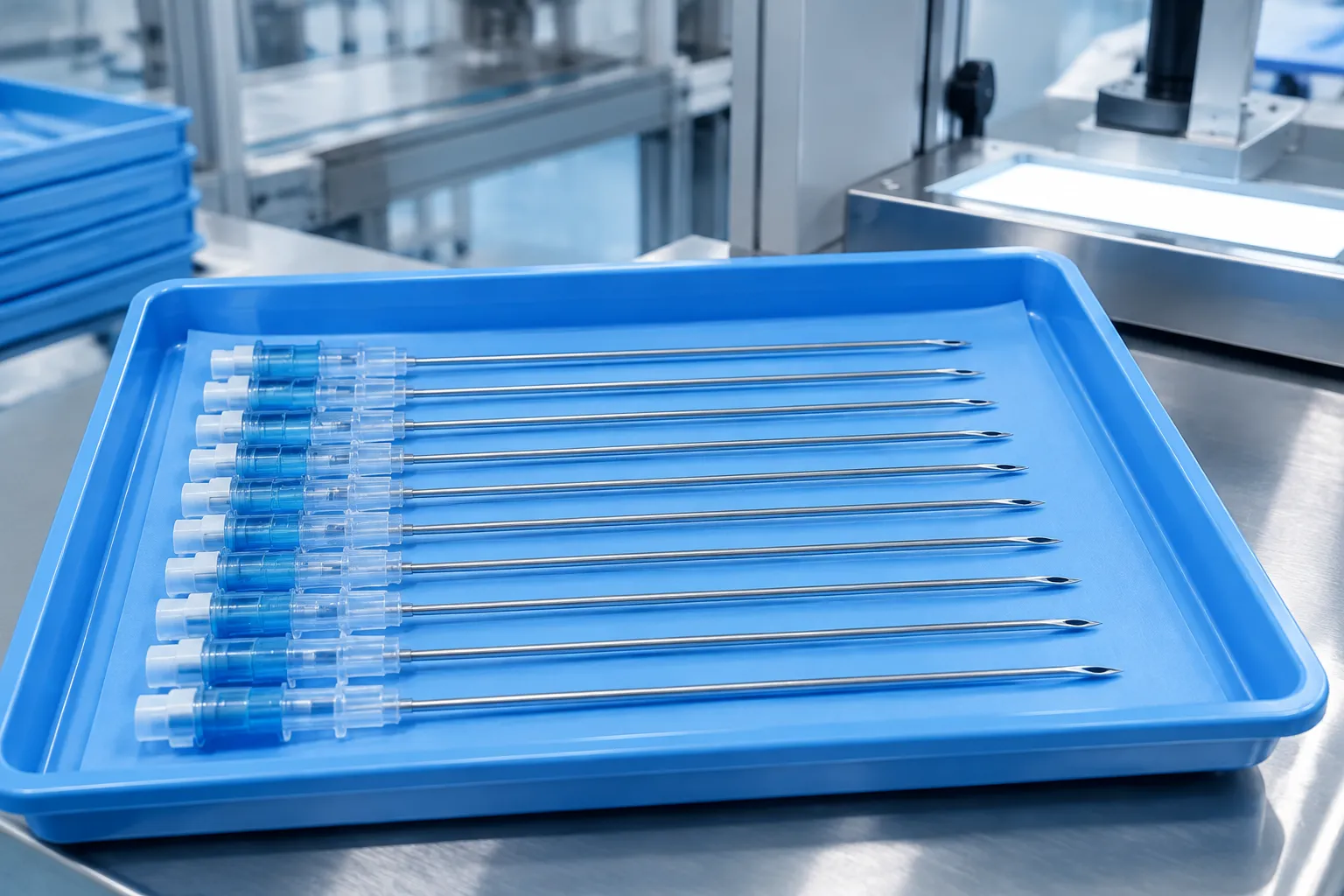
- 100% straightness check on release for guide and puncture families — sampling a needle line is sampling a risk.
- Surface inspection under magnification for tooling contact evidence; zero-scratch acceptance.
- Cut-face quality — burr-free, smooth cuts verified per lot, since downstream grinding or tipping inherits every cut defect.
- Material certificate linkage — stainless and titanium lots traced to machine parameters, the record medical audits ask for.
FAQ
What tolerance can a needle straightening machine hold?
Guide and puncture needle lines work to 0.01 mm-class straightness on release, with the machine measuring in a support state that does not deflect the tube — the needle equivalent of loaded-versus-released measurement discipline.
Can the machine handle hollow capillary tubing?
Yes — capillary (hollow) pipes are a core scope, in stainless steel, titanium and the other listed materials. Roller and contact geometry is chosen so the tube is corrected, not ovalized.
Do you supply the cutting function in the same machine?
The straightening and cutting functions ship as one cell, with output counting and stability alarms, so needle blanks leave the machine ready for grinding and finishing.
For needle drawings, tubing specifications and target straightness, contact us — related lines: medical drill straightening and the medical device solutions hub.