
AMH-R40 Rod Straightener

AMH-R40 Rod Straightening Machine
- Straightening Method: designed with the Single curve roller
- Power transmission: AC motor+ Gear Box+ Belt
- Suitable length: Min.800mm
- Suitable Diameter: 0-40mm for rod workpiece and 10-40mm for pipe workpiece
Also we can design the machine with the CE standard and higher Automation level (Remote Diagnosis/ Workshop Automation)
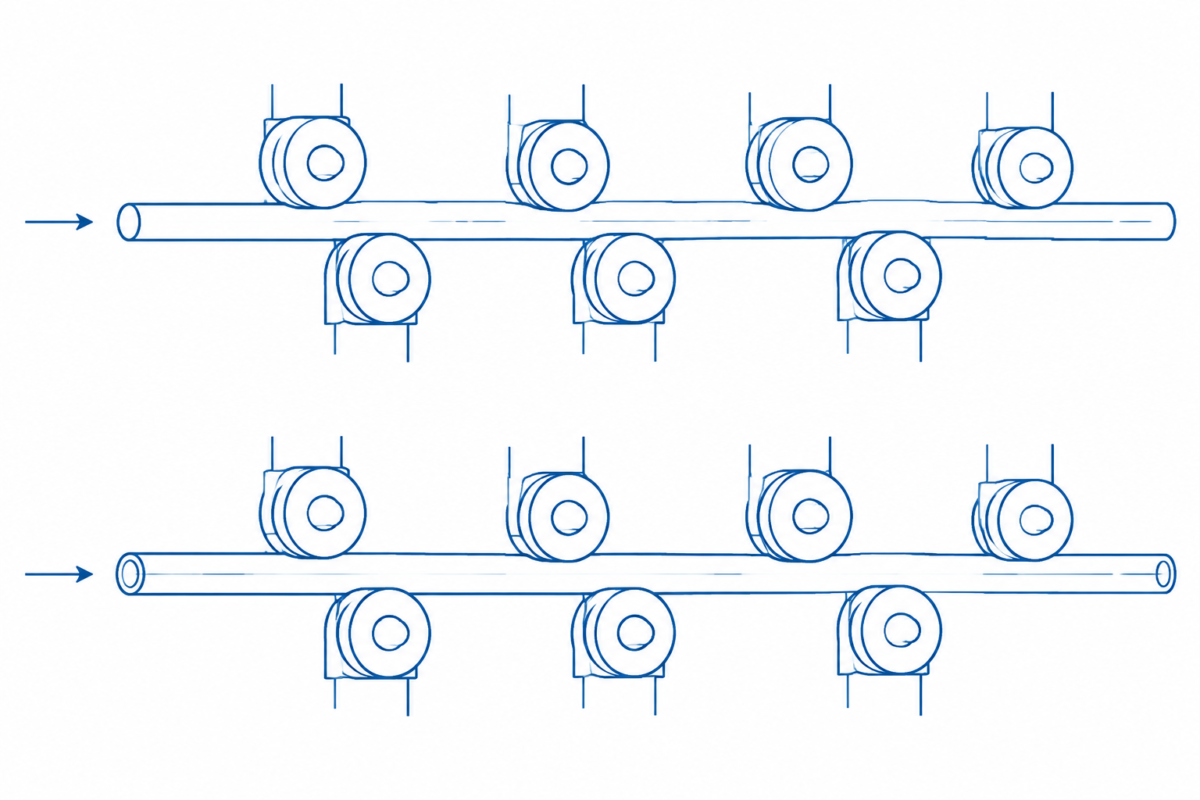
About the AMH-R40 Rod Straightening Machine
The AMH-R40 is a rod and pipe straightening machine with a single curve roller design, driven by an AC motor with gear box and belt transmission. It covers solid rod workpieces up to 40 mm in diameter and pipe workpieces from 10 mm to 40 mm, with a minimum workpiece length of 800 mm — positioning it for long bar and tube stock that the smaller AMH-R25 (20–30 mm rods, from 350 mm length) hands over as diameters and lengths grow.
How Roller Straightening Works
In roller straightening the workpiece is fed through rolls arranged to bend it alternately in opposite directions along its length. Each bending step stresses the surface fibers beyond yield while the core stays elastic, so the bar or pipe springs back straighter rather than returning to its old curvature. Over successive roll stations the residual stress distribution inside the material is equalized — which is why the corrected geometry stays stable in later handling, machining and heat.
The single curve roller arrangement is the classical configuration for straight round stock of a consistent diameter family. Its strength is distributed curvature: bows spread over the whole length respond best to a process that works the full length at once, rather than a press that corrects one point at a time. The AC motor, gear box and belt drive keep the feed steady under load, protecting the surface finish on both solid rods and pipe.
Rod and Pipe Workpieces
- Solid rods: up to 40 mm diameter
- Pipe and tube: 10 mm to 40 mm diameter
- Length: minimum 800 mm
- Straightening method: single curve roller
- Transmission: AC motor + gear box + belt
- Typical parts: round steel bars, shaft and piston-rod stock, guide bars, and straight tube sections within the envelope
Pipe straightening adds one consideration over solid rod: the wall. Tubes with light walls react more sensitively to roll interference, so wall thickness and material belong in every pipe inquiry.
Selection Guide: Rod and Pipe Straightening
- Solid or tubular. Rod up to 40 mm and pipe 10–40 mm are both in scope; the roll configuration differs, and mixed rod/pipe production should be declared in the inquiry.
- Length. The 800 mm minimum is set by roll engagement and feed geometry. Shorter parts need a different machine concept.
- Material and prior processing. Yield strength, drawn or peeled surface, and heat-treatment state determine how much correction the process applies per pass.
- Downstream tolerance. Define what the next operation needs. Where very tight straightness must be proven per part, ask about combining the roller machine with a straightness checking unit.
For smaller rods (20–30 mm, from 350 mm length) the AMH-R25 covers the range; all models are listed on the bolt & rod straightening machine page.
CE Standard and Automation
The AMH-R40 can be designed to CE standard and to a higher automation level, including remote diagnosis and workshop automation — connecting the machine into your line control and support processes.
FAQ
What can the AMH-R40 straighten?
Solid rods up to 40 mm diameter and pipe workpieces from 10 mm to 40 mm diameter, with workpiece length from 800 mm.
What is the difference between the AMH-R40 and AMH-R25?
The R25 handles 20–30 mm rods from 350 mm length; the R40 extends diameter to 40 mm, adds pipe capability (10–40 mm) and starts at 800 mm length. Both use the single curve roller principle.
Can it straighten tube as well as solid bar?
Yes, pipe from 10 mm to 40 mm diameter. State the wall thickness with your inquiry so the roll setting matches the tube.
What does single curve roller mean?
The rod passes through rolls that bend it alternately in opposite directions, plastically correcting the full length and equalizing internal stress — the classical method for straight round stock.
Is CE certification available?
Yes, and remote diagnosis plus workshop automation can be engineered in.