
AMH-R25 Rod Straightener

AMH-R25 Rod Straightening Machine
- Straightening Method: designed with the Single curve roller
- Power transmission: AC motor+ Gear Box+ Belt
- Suitable length: Min.350mm
- Suitable Diameter: 20-30mm
Also we can design the machine with the CE standard and higher Automation level (Remote Diagnosis/ Workshop Automation)
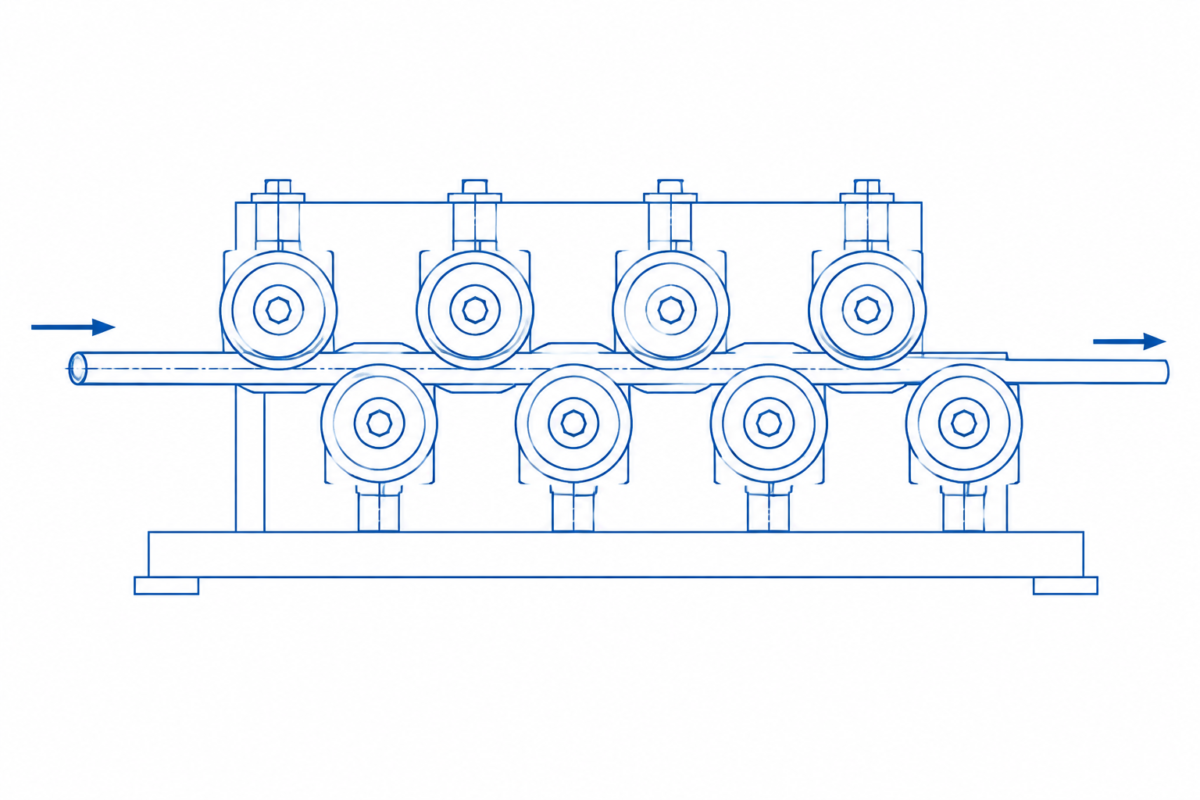
What the AMH-R25 Rod Straightening Machine Does
The AMH-R25 is a dedicated rod straightening machine built around a single curve roller design, driven by an AC motor with gear box and belt transmission. It processes solid round rods from 20 mm to 30 mm in diameter with a minimum workpiece length of 350 mm, restoring bent bar stock to the straightness your downstream operations require. Rods that leave forging, heat treatment, cutting or long-term storage almost always carry residual bends; feeding such rods into CNC turning, grinding or centerless processing accelerates tool wear and scatters tolerance. The AMH-R25 removes that variation at the source, delivering uniform bars that behave predictably in every later stage of your production line.
How Roller Straightening Works
In roller straightening, the rod is fed through a set of rolls arranged so that the bar is bent alternately in opposite directions along its length. Each pass combines elastic and plastic deformation: the surface fibers of the rod are stressed beyond their yield point while the core remains elastic, so the bar springs back to a straighter shape instead of returning to its original curvature. Repeating this alternating bend over several roll stations progressively equalizes the residual stress distribution inside the material, which is what makes the corrected geometry stable in later handling and machining.
A single curve roller arrangement is the classical configuration for straight, solid round stock of one diameter family. Because the bending line is consistent along the full bar length, the process is particularly effective for rods whose deviation is distributed over the whole length rather than concentrated in one sharp local kink. The mechanical transmission — AC motor, gear box and belt — keeps the feed steady under load, which matters for surface finish: a smooth, chatter-free pass avoids roller marks on the rod surface.
Suitable Workpieces for the AMH-R25
- Diameter range: solid round rods from 20 mm to 30 mm
- Length: workpieces of 350 mm and longer
- Typical candidates: solid round steel bars, shaft blanks, piston rod stock, guide rod blanks and similar straight round sections produced by drawing, turning, forging or heat treatment
- Condition: bars with distributed curvature over the length, as typically caused by heat treatment distortion, coil memory after cutting, or handling and storage deformation
If your workpieces fall outside these boundaries — smaller diameters, shorter lengths, or tubular material — the AMH-R40 rod and pipe straightening machine covers a wider envelope, or contact us to confirm the right configuration for your parts.
Selection Guide: Choosing a Rod Straightener
Four variables decide which rod straightening configuration fits a production line:
- Diameter window. Roll geometry is matched to the diameter family you run. A machine sized for 20–30 mm bars keeps roll contact pressure and deflection control in the correct range; running widely different diameters on one roll set degrades both results and roll life.
- Length limits. The minimum length (350 mm on the AMH-R25) is set by the feed and roll engagement geometry. Shorter parts need a different feeding concept.
- Material and condition. Yield strength, prior heat treatment state and whether the bar has been drawn or peeled all influence how many passes or how much roll interference the process needs.
- Straightness specification. Define the tolerance your downstream operations actually require. Tighter specifications may call for measurement after straightening; ask about integrating a straightness checking unit into the cell.
Send us the workpiece drawing, material grade and the straightness tolerance you need to hold — we confirm the machine configuration and the achievable result before you order. See the full bolt & rod straightening machine range for comparison.
CE Standard, Automation and Cell Integration
The AMH-R25 can be engineered to CE standard, and to higher automation levels including remote diagnosis and workshop automation. In automated rod processing cells the straightener is frequently combined with upstream loading and downstream unloading, so that bars flow from cutting or heat treatment through straightening without intermediate stacking. Remote diagnosis capability lets our engineers check machine status and support commissioning without travel delays — a practical advantage for production sites outside China.
FAQ
What diameters can the AMH-R25 straighten?
Solid round rods from 20 mm to 30 mm in diameter. The AMH-R40 extends this to rods up to 40 mm and also handles pipe workpieces.
What is the minimum workpiece length?
350 mm. Parts shorter than the roll engagement length cannot be guided through the rolls reliably and need a different straightening concept.
How straight can a roller-straightened rod get?
The achievable straightness depends on material, diameter, length and incoming condition. Because roller straightening redistributes residual stress rather than forcing a single correction point, results are consistent along the whole bar. Share your straightness tolerance with us and we will confirm what the process achieves on your parts.
Can the machine run unattended?
Roller straightening is inherently a through-feed process and suits automated feeding. The machine can be supplied with higher automation levels, remote diagnosis and workshop automation integration on request.
Does rod straightening damage the surface?
With correct roll matching and steady feed, the process leaves the bar surface intact. Correct roll set selection for the diameter family is part of the machine configuration we confirm with your workpiece data.